Digital marketing statistics are usually served as a firehose of numbers with no shape, so you scroll, nod, and remember none of it. We took a different route. This piece pulls the figures that actually change decisions in 2026, groups them into four questions that matter, and charts the ones worth seeing rather than just reading. The point is not to impress you with big numbers. It is to help you spend your next rupee where it does the most work.
A note on honesty first. Every figure here comes from published 2026 industry reporting, and estimates vary by source, so treat these as the direction of travel rather than gospel to two decimal places. What holds across almost all of them is clear: attention has moved to mobile, social keeps swallowing budgets, and email quietly outperforms everything on return. Keep those three truths in mind and the rest of the digital marketing statistics below start to line up into a strategy.
Where the money actually goes
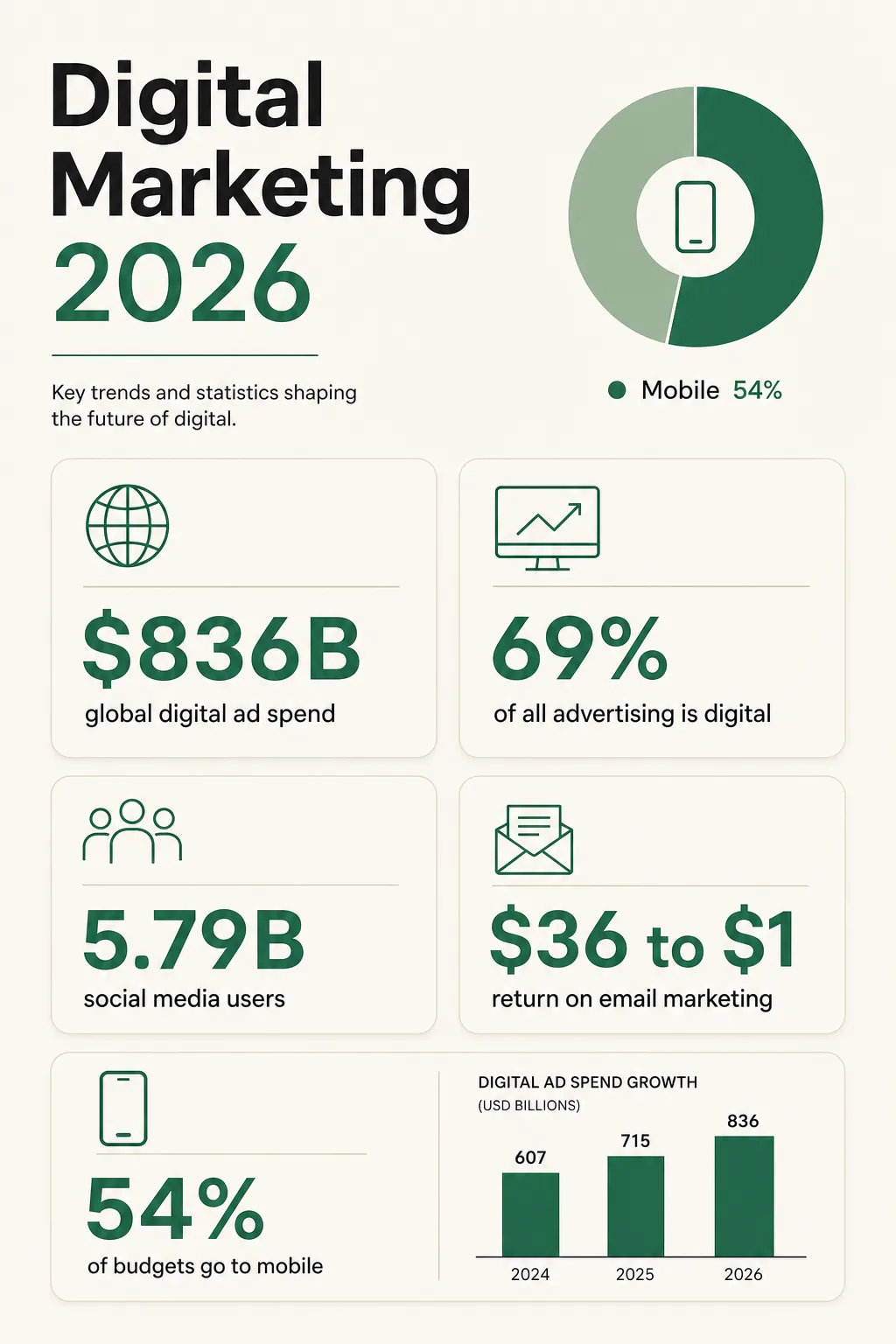
Global digital ad spend is projected around $836 billion in 2026, and digital now makes up close to 69% of all advertising worldwide. Search leads the pack at roughly $306 billion, with social media advertising close behind near $339 billion and the rest spread across display and video. The takeaway is not that search and social are big. It is that they are where competition and cost are highest, so winning there needs craft, not just budget. Smaller players often get better returns in the gaps everyone else ignores.
Nearly everyone is on social
Social media reached about 5.79 billion user identities by early 2026, which is close to 70% of the entire global population, growing over 5% year on year. That scale is why the social ad market keeps climbing, projected near $339 billion in 2026 and forecast to grow at roughly 12% a year through the end of the decade. But reach is not the same as attention. The platforms are more crowded than ever, and organic visibility keeps shrinking, so a presence on every network is a worse plan than doing one or two properly.
Email still wins on return
Here is the number that surprises people every year. Email marketing returns about $36 for every $1 spent, the highest return of any channel, while the average across digital marketing sits closer to $5 per $1. Email is not glamorous and it does not trend, which is exactly why it stays profitable. It reaches people you already own the relationship with, on your schedule, without paying a platform for the privilege. If your business has neglected its list, the chart below is the case for fixing that before you buy another ad.
Mobile is the whole game
Attention has finished its move to the small screen. By 2026, smartphones drive close to 69% of total ad spending, mobile captures roughly 54% of digital advertising budgets, and around 92% of internet users reach the web primarily through a phone. For an Indian audience this is even more pronounced, where mobile-first is not a strategy but the only reality. If your site, emails and checkout are not fast and clean on a phone, you are leaking most of your potential customers before they ever see your offer.
- Mobile54%
- Desktop & other46%
The 2026 numbers in one place
If you skim nothing else, skim this. Each figure below points to one decision you can act on this quarter.
| Metric | 2026 figure | Why it matters |
|---|---|---|
| Global digital ad spend | ~$836 billion | The pond keeps growing; so does the competition |
| Digital share of all advertising | ~69% | Offline-first budgets are now the exception |
| Social media users | ~5.79 billion | Reach is easy; attention is the scarce part |
| Email marketing ROI | ~$36 per $1 | Highest return of any channel, so feed your list |
| Mobile share of digital budgets | ~54% | Build and test everything phone-first |
What the numbers mean for you
Strip away the billions and the story for a small business is simple. Do not try to be everywhere. Pick the one or two social platforms where your customers actually spend time and commit to them. Treat your email list as the asset with the best return you own, and feed it consistently rather than only when you want something. Build everything mobile-first, because that is where the traffic already lives. The giants will keep spending their billions on search and social, and you cannot outbid them, but you can out-focus them.
Final word
The most useful digital marketing statistics are the ones that tell you where to stop spreading yourself thin. The 2026 data is consistent: mobile owns attention, social owns scale, and email owns return. You do not need a bigger budget to act on that, you need a narrower one aimed better. Choose your channels on purpose, protect and grow your email list, and make the phone experience effortless. Read this way, digital marketing statistics stop being trivia and start being a map to your next good decision.
FAQs
Global digital ad spend is projected at around $836 billion, which is close to 69% of all advertising worldwide. The pond gets bigger every year, but so does the competition for attention inside it.